

A Clear Look at CYBHI vs. LEA-BOP: Helping Districts Choose the Right Fit
If you've ever submitted a mental health billing claim and waited two years to see the money, you already understand the core problem CYBHI was designed to solve. But CYBHI (California's Children and Youth Behavioral Health Initiative) isn't just a faster version of the old program. It's a fundamentally different approach to how schools get reimbursed for the mental health work they're already doing every day.
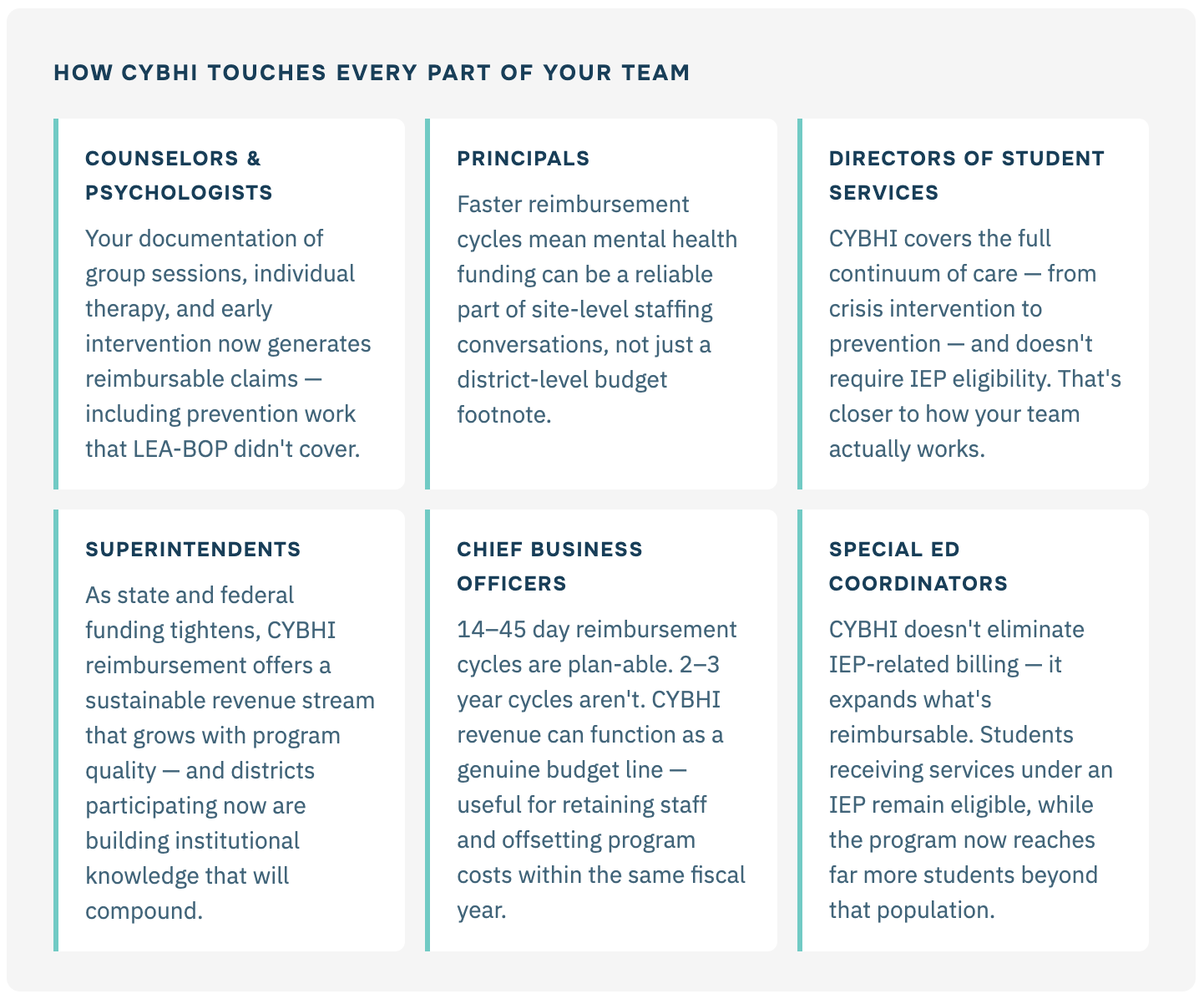
Whether you're the counselor documenting sessions, the psychologist conducting assessments, the principal wondering how to keep your support staff funded, or the CBO trying to make next year's budget work, this matters to you.
The Problem With the Old Approach
For 20 years, the LEA-BOP program (Local Educational Agency Billing Option Program) served as the main federal pathway for schools to access Medicaid reimbursement for mental health services. And for 20 years, it quietly accumulated structural problems that made it increasingly difficult to use.
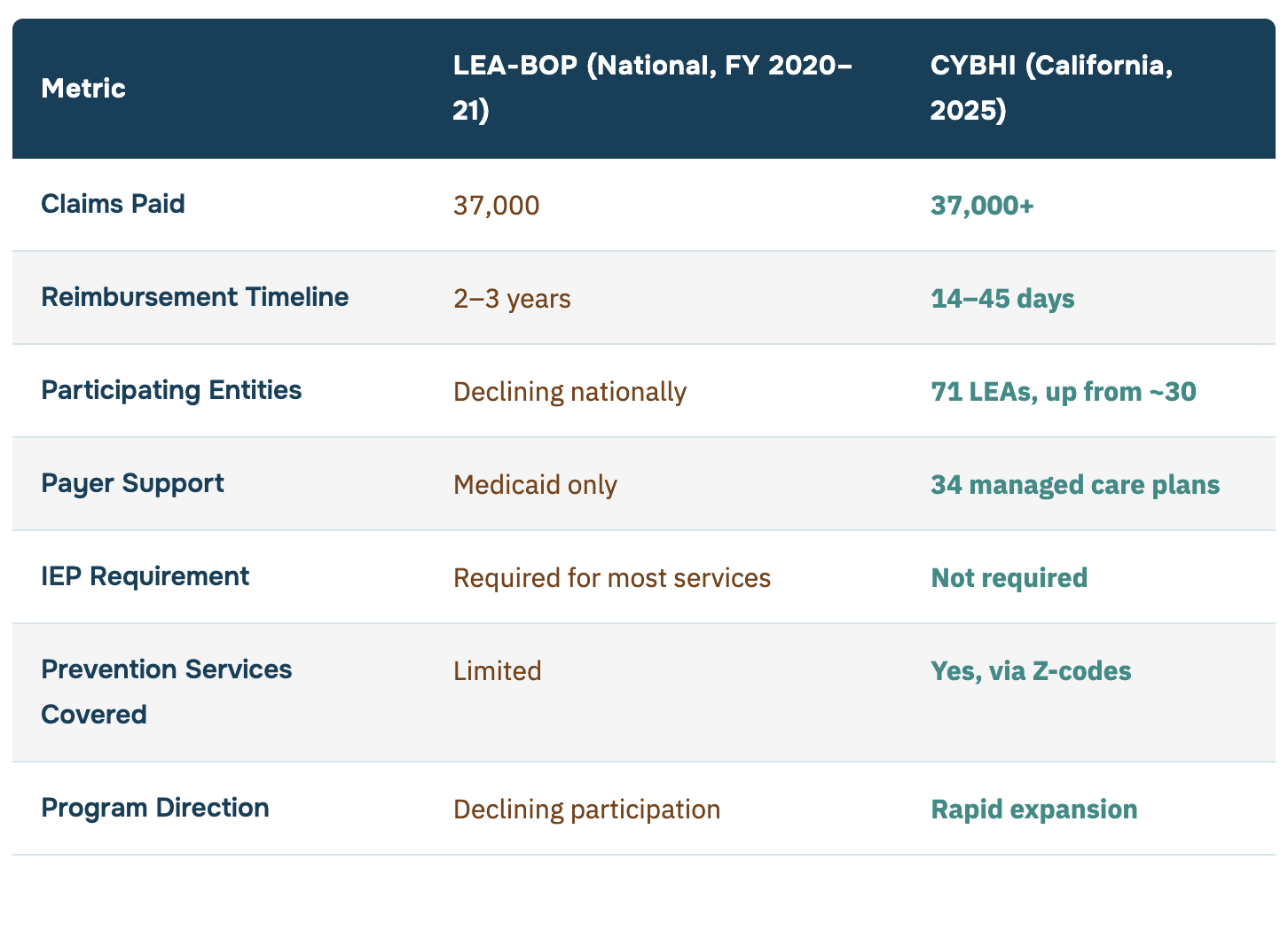
Claims routinely took 2 to 3 years from service to payment. The compliance requirements, including federal cost allocation methods and complex random moment time studies, effectively required districts to employ dedicated billing specialists just to participate. Coverage was largely limited to students with IEPs who were also Medicaid-eligible. And participation has been declining nationally for years: from 149,500 claims in FY 2014-2015 to just 37,000 in FY 2020-2021.
In 2022, Pennsylvania returned $500 million to the federal government due to compliance failures. That number tells you something about the risk-to-reward ratio districts were navigating.
When reimbursement takes three years, it can't sustain staffing. It can't stabilize a budget. It becomes a windfall, if it arrives at all.
How CYBHI Works Differently
California designed CYBHI by examining what wasn't working in LEA-BOP and building around it. The results from the first year of full operation give us a concrete picture of what that looks like in practice.
- 14 to 45 days average from claim submission to payment
- 37K+ claims paid in 2025, matching LEA-BOP's entire national volume
- 8K+ students served through CYBHI in 2025
- 34 managed care plans paying CYBHI claims
Of the $2.7 million submitted in 2025, more than $2.2 million was reimbursed. Participating LEAs grew from roughly 30 to 71 over the course of the year. The trajectory is up, not down.
Five Differences That Matter to Your Role
1. Reimbursement Speed LEA-BOP: 2 to 3 years. CYBHI: 14 to 45 days on average. For counselors and psychs, this means the documentation work you do now translates into real resources for your team within the same school year, not a hypothetical future budget line.
2. Who Qualifies LEA-BOP reimbursement is primarily tied to IEP services for Medicaid-eligible students. CYBHI covers individual therapy, group counseling, case management, crisis intervention, and prevention services, regardless of IEP status. It uses Z-codes to capture prevention-focused care, which means the student you see three times before anything escalates counts too.
3. Compliance Burden LEA-BOP requires navigating federal Medicaid rules, complex cost allocation methodologies, and random moment time studies (RMTS). CYBHI uses a streamlined fee schedule with clear service definitions and no RMTS. Districts shouldn't need a full-time billing specialist to access the funding schools have earned.
4. Payer Coverage LEA-BOP is Medicaid only. CYBHI launched as a multi-payer program from day one. 34 managed care plans paid claims in 2025 alone. Schools serve every student, and the reimbursement structure is finally starting to reflect that.
5. Technology Infrastructure LEA-BOP operates on legacy federal billing systems with manual reconciliation. CYBHI uses cloud-based billing with real-time claims submission and automated workflows. Less time chasing claim status, more time doing the work.
What This Means for Your Specific Role
The Bigger Picture
California designed CYBHI by studying what two decades of LEA-BOP implementation taught us. The first year suggests it's working: claims are increasing, more LEAs are participating each month, and reimbursements are flowing consistently enough that districts are using them to retain mental health staff and stabilize funding during difficult budget cycles.
That last part matters more than any single data point. When school-based mental health funding is predictable, districts can hire for it. When it's predictable, counselors and psychologists have caseloads they can sustain. When it's predictable, students get continuity of care, not a new face every time a grant runs out.
CYBHI matched LEA-BOP's entire national claim volume in its first year, in one state, while paying faster and covering more students. The question for California districts is no longer whether CYBHI works. It's how quickly your district can start capturing the reimbursement it's already earned.
About the data: LEA-BOP figures are sourced from CMS published reports (FY 1998-2021). CYBHI data is sourced from DHCS CYBHI Cohort Calls and TadHealth's 2025 CYBHI Industry Report. All figures represent actual program performance, not projections.


